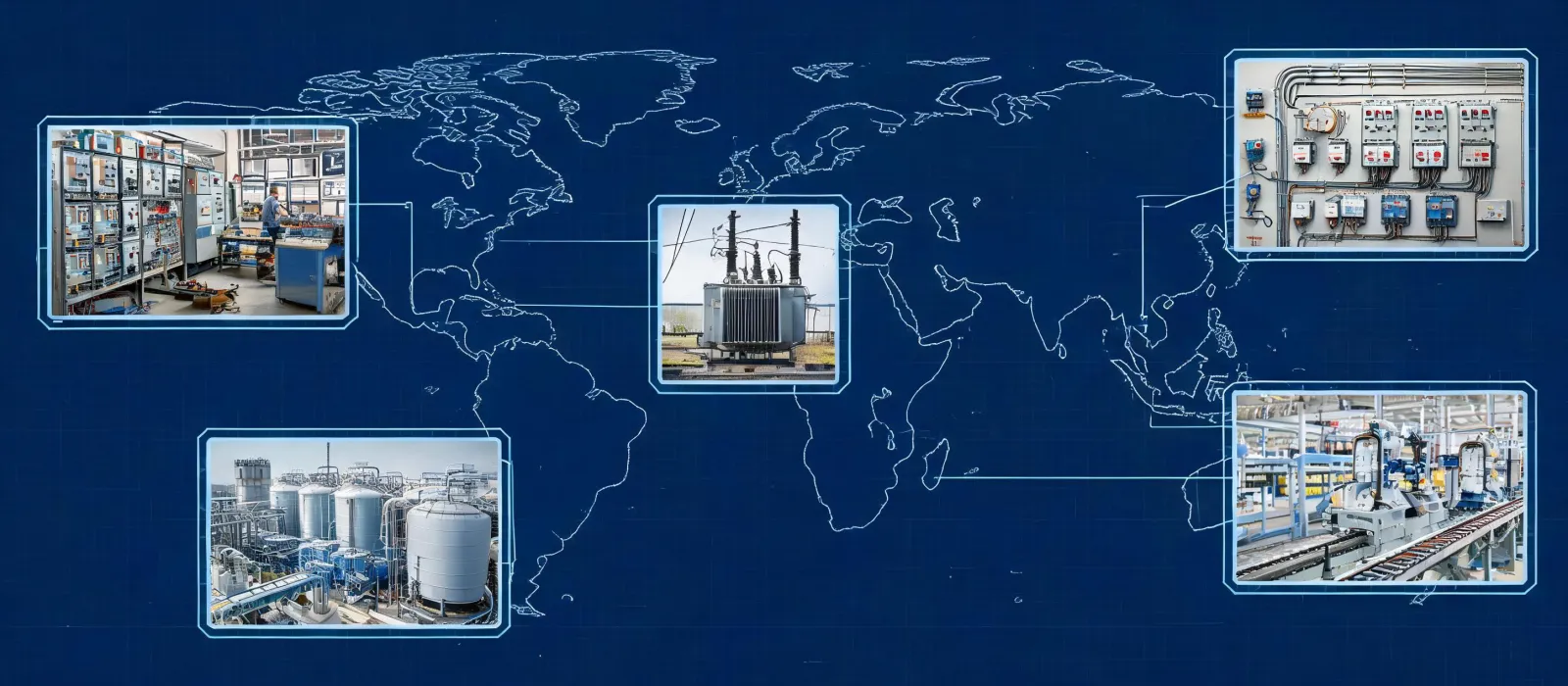
Map of transformer application environments

Applications organized by operating context

Acme Transformer support across industrial power environments

A transformer selected for a dry indoor panel does not automatically suit a hot process area, outdoor service point or harmonic-rich load. Browse the regional application patterns below, then validate the actual voltage, frequency, phase, enclosure and thermal conditions at the installation.

Where specification priorities change

Panel builders and industrial controls

Control transformers may serve contactor coils, relays, PLC power supplies and auxiliary circuits. Review primary and secondary voltages, continuous VA, inrush, 50/60 Hz duty, taps, fuse or breaker protection, terminal arrangement and available panel space.

Certification and marking expectations depend on the specific series and panel program. A substitute also needs its mounting footprint, clearances and wiring diagram checked.

OEM machinery for multiple destinations

Export machinery can face different source voltages, frequency and conformity requirements. A multi-voltage design may simplify variants, but added taps or winding complexity can affect size, connection discipline and cost. Engineering should define which connections are field selectable and which require factory configuration.

Distributed control can improve local fault isolation, while centralized architectures simplify common strategy and data management. Transformer placement should follow the chosen architecture and protective coordination.

Commercial and process facilities

Lighting, HVAC controls, water treatment skids and maintenance power each create different load profiles. Ambient heat, enclosure ventilation, dust, moisture, harmonics and service access influence temperature rise and enclosure selection.

Conservative derating adds thermal margin and can support long-duty operation, but may increase footprint and initial cost. High utilization reduces size yet leaves less tolerance for elevated ambient temperature or future load growth.

A practical review sequence

Specification weight by decision stage

The bars express review emphasis, not product performance claims. Every installation still requires model-specific data.

Electrical ratingsFirst gate
Load and dutyThermal basis
Mechanical fitInstallation gate
Documents and standardsApproval gate

Fuses or circuit breakers?

Fuses can provide fast current limiting with simple construction. Circuit breakers can be reset, monitored and equipped with broader protective functions. The correct choice depends on available fault current, selective coordination, maintenance policy and lifecycle cost rather than a universal preference.

Efficiency or derating margin?

A compact, highly utilized transformer may reduce material and panel footprint. Conservative loading can improve thermal headroom in high ambient temperatures or continuous service. Harmonic content, ventilation and expected load growth belong in that decision.

Map your installation before selecting a series

Share source voltage, required secondary voltage, phase, frequency, connected load, inrush, ambient temperature, enclosure exposure, available dimensions and destination market. We will return the open questions and document path needed for a reviewable quote.